HASSAN
https://www.youtube.com/@Hassanzir
Identity
Engagement Breakdown
HASSAN's Creations
Back to Profile
@MUHAMMAD • 20 hours ago • central
Revenue Overview
Today's Revenue
0.0000 GUV
Lifetime Revenue
0.0000 GUV
Lifetime Breakdown
HASSAN reposted

@Mulodizeki 1 day ago
By NHL Mulodizeki
Publication Date: 20 October 2026
Programme Launch: 1 January 2027
Programme Duration: 12 Months
Pioneer Cohort: 50 Ugandans
50 Ugandans. One Year. A Journey Toward Visionary Leadership.
Introduction: The Internet Needs More Than Users — It Needs Visionaries
The world has connected billions of people through the internet, creating unprecedented access to information, communication, entertainment, education, business, and global communities. Yet one important question remains: How many internet users are transforming their participation into knowledge, creativity, ownership, economic value, and lasting impact?
Every day, people watch videos, read articles, join online communities, share content, exchange ideas, learn new skills, and interact with digital platforms. These activities make the internet an important part of modern life. However, participation can become far more powerful when people learn how to use their digital experiences to create something meaningful.
Imagine a world where a student does not simply watch educational content but turns what they learn into a useful project. Imagine a parent who helps their children develop digital confidence, creative thinking, and responsible participation. Imagine a young person who transforms an idea into a practical solution for their community, a content creator who develops a sustainable digital presence, or an ordinary internet user who discovers the power of building rather than merely consuming.
This is the opportunity behind the GOFORUSNET Builder Pioneer Initiative (BPI) and its LECMOS learning journey.
Beginning on 1 January 2027, the initiative will introduce a selected pioneer cohort to a structured, year-long journey through the GoforusNet ecosystem, with GCM's Content Monetization framework providing an environment in which digital participation, creation, and economic value can be understood as connected activities.
This is not simply about learning how to use another online platform. It is about learning to approach the internet with a different mindset.
The future belongs not only to those who can access information, but also to those who can understand it, apply it, transform it into useful work, and help others benefit from what they create.
1. Understanding the GOFORUSNET Builder Pioneer Initiative
The Builder Pioneer Initiative is a one-year development programme intended to nurture people who want to move beyond ordinary digital participation and develop the knowledge, habits, capabilities, and vision required to become builders within the GoforusNet ecosystem.
The first planned cohort is built around the idea of 50 Ugandans coming together for one year to pursue a common journey toward visionary leadership.
A focused pioneer cohort can provide an environment in which people learn together, exchange experiences, develop projects, encourage one another, and demonstrate what structured digital learning can look like in practice.
Every participant comes with a different starting point. One may already be a content creator. Another may be a student, parent, entrepreneur, community organizer, professional, or someone still discovering the possibilities of the internet. Some may have advanced digital skills, while others may be beginning with little more than a smartphone, an internet connection, and a willingness to learn.
The initiative recognizes that people do not need identical backgrounds to pursue meaningful growth.
What matters is the willingness to learn, explore opportunities, create useful work, develop responsible habits, and apply knowledge in ways that contribute to personal and collective progress.
Through GCM, participants can explore the relationship between digital participation, content creation, contribution, and monetization. Through LECMOS, they can follow a structured pathway that helps connect these activities into a broader development process.
The ultimate purpose is to cultivate people who can think independently, act responsibly, build with intention, recognize opportunities, and contribute to the development of the communities around them.
2. Why a New Approach to Digital Participation Is Necessary
The internet has opened doors that previous generations could hardly imagine. People can learn from institutions across the world, communicate across borders, publish their ideas, discover new markets, and participate in digital communities without necessarily needing to relocate.
However, access alone does not automatically translate into capability.
The first challenge: Consumption without creation
Many people spend significant time consuming online information and entertainment without developing a habit of applying what they learn.
They may watch tutorials but never complete a project. They may save useful articles but never organize the information. They may have excellent ideas but never document or test them.
The problem is not consumption itself. Learning often begins by observing and listening. The challenge is what happens afterward.
The opportunity is to turn consumption into a starting point for creation.
A person who watches a lesson can write a summary, test a new skill, develop a resource, create a solution, or teach someone else what they have learned.
The second challenge: Knowledge scattered across digital spaces
Internet users frequently collect information across messaging applications, social platforms, videos, websites, notebooks, and personal files.
Useful ideas become difficult to retrieve. Learning experiences are forgotten. Project plans become disconnected from the research that inspired them. People repeatedly search for information they have already encountered.
The solution is to develop better knowledge-management habits: recording information, organizing notes, identifying reliable sources, connecting related ideas, and returning to earlier work when making decisions.
A well-organized knowledge base becomes more than a collection of notes. It becomes a personal resource that supports future thinking, planning, creativity, and problem-solving.
The third challenge: Ideas that never become action
Ideas are abundant. Execution is more demanding.
A person may identify a community problem, imagine a new business, or recognize an opportunity in digital content. Yet without a process for defining the problem, exploring alternatives, setting goals, testing assumptions, and evaluating results, the idea may remain an aspiration.
BPI's learning philosophy encourages participants to treat ideas as beginnings rather than finished achievements.
Ideas can be recorded, explored, refined, tested, and transformed into practical projects. Progress can be measured through what a person learns, produces, improves, and contributes.
The fourth challenge: Unclear pathways from participation to value
People often understand that the internet can create opportunities, but they may not understand the different activities involved in developing something valuable.
Creating useful content is different from building an audience. Building an audience is different from developing a product. Publishing is different from maintaining ownership of one's work. Generating attention is different from creating sustainable value.
GCM's Content Monetization framework provides the context for exploring these relationships within the GoforusNet ecosystem.
The Builder journey can help participants understand how learning, contribution, content creation, audience engagement, and ownership fit into a broader process of value creation.
The fifth challenge: Limited digital confidence and unequal access
Not everyone begins with the same devices, resources, technical knowledge, language skills, or professional networks.
Some people have access to powerful computers and advanced software. Others rely on entry-level smartphones and limited connectivity. Some are confident publishing their work, while others hesitate to share even a simple idea.
A global digital future must make room for these differences.
A person's starting point should not define the limits of their imagination. Practical learning, accessible tools, peer support, and steady progress can help people develop capabilities at their own pace.
The goal is not to make everyone identical. It is to help more people participate meaningfully and develop their own strengths.
3. GCM: A Framework for Connecting Participation, Creation, and Monetization
GoforusNet provides the wider ecosystem in which participants can explore digital participation, create content, develop ideas, connect with others, and learn about opportunities for generating value.
Within this context, GCM's Content Monetization framework is important because it encourages people to examine how digital activities can contribute to value creation.
Monetization should not be understood as an isolated final action that begins only after someone becomes popular. It is better understood as one part of a wider process involving useful work, audience needs, relevance, quality, contribution, and the development of sustainable opportunities.
A creator may begin by learning about a subject, exploring the needs of a particular audience, producing useful content, improving that content through feedback, and understanding how it can support an economic activity.
An aspiring entrepreneur may begin with research, identify a problem, develop a prototype, gather feedback, and explore possible ways to sustain the solution.
A student may develop a portfolio that demonstrates practical skills and helps communicate their capabilities to potential collaborators or employers.
These examples show that digital value can take different forms. It can be educational, creative, social, professional, entrepreneurial, or economic.
The Builder Pioneer Initiative places these possibilities within a structured learning experience so participants can better understand the connections between their knowledge, their activities, and the value they seek to create.
The ambition is to help people become more intentional about their digital lives: not simply asking what a platform can provide to them, but also asking what they can learn, build, improve, and contribute through their participation.
4. LECMOS: The Six Stages of the Builder Journey
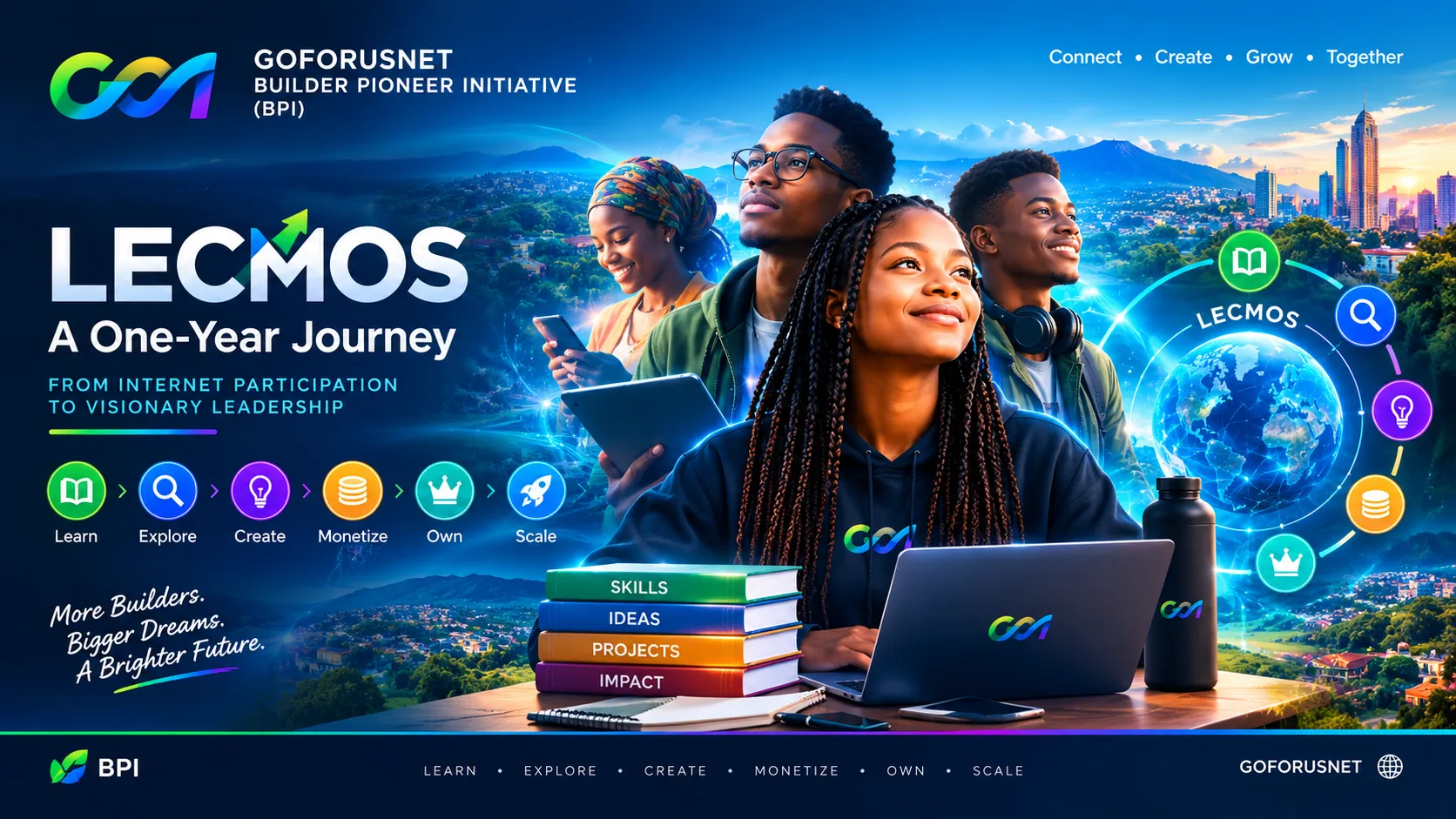
At the heart of BPI is LECMOS: Learn, Explore, Create, Monetize, Own, Scale.
LECMOS provides a six-stage learning framework that connects knowledge acquisition with practical development, value creation, ownership, and growth.
The twelve-month programme allocates approximately two months to each stage, creating a broad progression that participants can use to organize their learning and development.
Stage One: LEARN — Months 1–2
Every meaningful journey begins with a foundation.
The Learn stage focuses on building understanding, strengthening digital awareness, developing productive habits, and learning how to work with information.
Participants can examine how they currently use the internet, identify areas where they want to improve, and develop habits that support more intentional participation.
This stage can include learning how to organize knowledge, record observations, evaluate information, identify useful resources, establish goals, and reflect on personal progress.
The LECMOS Smart Workspace and Notebook can support this process by giving participants a place to record lessons, maintain a learning journal, capture questions, and organize their developing understanding.
Instead of allowing valuable information to disappear into a long stream of online activity, participants can begin building a personal knowledge resource.
The central question: What do I need to understand before I can build something meaningful?
Stage Two: EXPLORE — Months 3–4
Learning becomes more powerful when people begin connecting knowledge to real opportunities.
During Explore, participants can investigate subjects that interest them, observe the needs of different audiences, examine community challenges, study examples of digital innovation, and identify problems worth solving.
Exploration requires curiosity and an open mind. It also requires the willingness to ask questions, compare perspectives, challenge assumptions, and learn from experience.
A participant interested in education may explore ways to make learning resources more accessible. Someone interested in agriculture may investigate how digital information can support farmers. A creative person may explore new ways to communicate local culture, ideas, or skills to a global audience.
The aim is not to force every participant into the same field. It is to help each person identify areas where their interests, abilities, and the needs of others can intersect.
Research libraries, idea collections, mind maps, and organized notes can help participants connect observations and identify promising directions.
The central question: What opportunities, needs, or problems can I understand well enough to address?
Stage Three: CREATE — Months 5–6
Creation turns knowledge and exploration into something tangible.
During this stage, participants can begin transforming their ideas into practical work. Depending on their interests, that work may include educational content, digital resources, creative projects, community initiatives, prototypes, business concepts, or other useful outputs.
Creation involves more than producing something once. It includes planning, experimenting, receiving feedback, making improvements, and learning from mistakes.
A first draft may be imperfect. An early project may reveal weaknesses. Feedback may show that an idea needs to be simplified or redirected.
These experiences are part of development.
The Smart Notebook can support creation by linking research, project plans, tasks, drafts, reflections, and supporting materials. A participant can see how an idea developed from an initial observation into a more structured piece of work.
The central question: What can I create that demonstrates what I have learned and provides value to others?
Stage Four: MONETIZE — Months 7–8
Monetization introduces the relationship between created value and economic opportunity.
At this stage, participants can explore how useful content, products, services, skills, and contributions may support income-generating activities within appropriate digital environments.
This includes learning to recognize audience needs, understand the value of quality and relevance, improve communication, examine possible business models, and identify suitable ways to present or distribute work.
For content creators, this may involve studying how content attracts and serves an audience. For entrepreneurs, it may involve exploring customer needs and the potential value of a product or service. For people developing professional skills, it may involve understanding how a portfolio can demonstrate capabilities.
Within GCM, participants can study the relationship between participation, content, contribution, and available monetization opportunities.
The important shift is from creating without purpose to understanding how creation can solve problems, serve people, and generate economic value.
The central question: How can the value I create become part of a practical and sustainable economic opportunity?
Stage Five: OWN — Months 9–10
Growth becomes more meaningful when people understand what they are building and how to maintain it.
The Own stage focuses on ownership, responsibility, identity, continuity, and the long-term value of work.
Participants can learn to maintain records of their projects, organize original materials, document their contributions, preserve important knowledge, and present their work clearly.
They can also examine the importance of protecting personal information, respecting intellectual property, understanding permissions, and making responsible decisions about the content they publish.
Ownership is not limited to financial assets. It also includes the ability to understand one's work, maintain a record of progress, make informed choices, and take responsibility for the value one creates.
A well-maintained portfolio can help a participant demonstrate growth over time. Organized project records can preserve lessons learned. A clear record of original work can make it easier to explain the contribution behind an achievement.
The central question: What am I building, how do I maintain it responsibly, and what lasting value does it represent?
Stage Six: SCALE — Months 11–12
Scaling means extending the reach, usefulness, or impact of work that has been developed.
For some participants, this may involve reaching a wider audience. For others, it may mean improving a project, collaborating with additional people, developing a repeatable process, or adapting a solution for another community.
Scaling requires reflection. Before expanding an activity, builders need to understand what works, what needs improvement, which resources are necessary, and how growth can remain sustainable.
It also requires a broader perspective.
A solution developed in one Ugandan community may offer insights to people in other regions. A learning resource created for a small group may be adapted for a wider audience. A local idea may inspire collaboration across geographical and cultural boundaries.
The purpose is not simply to become bigger. It is to increase useful impact while maintaining quality, responsibility, and a clear understanding of the people being served.
The central question: How can I extend the value of what I have built and help others benefit from it?
5. The LECMOS Smart Workspace: Turning Learning into an Organized Practice
A structured learning journey becomes more effective when participants have a practical place to capture, organize, and apply what they learn.
The proposed LECMOS Smart Workspace and Notebook is intended to serve this role within the existing GCM experience.
Rather than functioning as an isolated application or a separate user profile, the workspace can connect notes, learning activities, research, ideas, projects, and portfolio records within the participant's existing digital environment.
Its value lies in the relationships between these features.
The Smart Notebook
The notebook provides a place to write lessons, develop thoughts, record observations, draft content, and document project plans.
Notes can be organized using folders, tags, search, related-note links, and the appropriate LECMOS stage.
Each note can also display its creation and editing date and time, making it easier to track the development of ideas.
A character counter can help users monitor the length of their writing. Autosave and version history can support continuity, while source records can help participants identify where their information originated.
The Journal
A learning journal encourages regular reflection.
Participants can record what they learned, what challenged them, what they achieved, what they need to improve, and what they intend to do next.
Over twelve months, these reflections can become a valuable record of personal development.
The journal can also help participants recognize patterns in their work, understand how their thinking changes, and identify lessons that might otherwise be forgotten.
The Idea Vault
Ideas often appear before a person is ready to develop them.
The Idea Vault provides a place to capture these ideas, add context, group related concepts, and revisit them when circumstances become more suitable.
An idea can eventually become a research question, a project, a piece of content, or a practical experiment.
The objective is to preserve curiosity while creating a path from imagination to action.
Research and Sources
Research tools help participants organize information from articles, books, lessons, videos, interviews, and other relevant sources.
Source records can include titles, authors or organizations, links, dates, and notes explaining how the information supports a particular idea.
This practice encourages responsible research, traceability, and proper attribution.
It also makes it easier to return to useful information when developing a project or checking an earlier conclusion.
Goals and Tasks
Ambition becomes more actionable when it is connected to manageable steps.
Goals and tasks can help participants divide larger objectives into smaller activities, set priorities, track progress, and maintain a record of completed work.
A goal to develop a digital resource, for example, may involve research, outlining, drafting, testing, revision, and publication.
The system can help connect these activities to the relevant project and LECMOS stage.
Mind Maps and Whiteboards
Some people understand ideas best through visual relationships.
Mind maps and whiteboards can help participants connect concepts, explore alternatives, map project structures, and identify relationships between problems and potential solutions.
These tools can be particularly useful when an idea is still developing or when a project contains many related parts.
Projects and Portfolio
Projects provide a structured space for turning ideas into completed work.
A project may connect its original idea, supporting research, tasks, drafts, files, collaborators, and final output.
Portfolio records can then help participants present selected work and demonstrate what they have created or learned.
Together, these features can help transform a year of learning from a collection of disconnected activities into a visible record of development.
AI-Assisted Thinking
Artificial intelligence can help users summarize notes, clarify difficult concepts, structure drafts, generate questions, identify possible next steps, and connect related ideas.
Used thoughtfully, an AI assistant can support learning without replacing the user's own judgment, creativity, or responsibility.
Participants can use AI to improve their thinking, organize information, and explore alternative approaches while remaining responsible for evaluating the accuracy and usefulness of the results.
The wider vision is a connected learning environment in which knowledge is not merely stored, but actively used.
6. Opportunities for Different Types of Internet Users
The strength of a global digital ecosystem lies in its ability to support people with different interests, experiences, and ambitions.
LECMOS is not limited to one profession or one type of creator. Its stages can be applied to many different paths.
Students and young learners can develop research habits, organize their learning, build projects, and create portfolios that demonstrate their capabilities.
Parents and families can encourage responsible digital participation, help young people develop useful skills, and explore educational and creative activities together.
Content creators can improve their research, planning, consistency, audience understanding, and ability to turn creative work into opportunities.
Entrepreneurs and aspiring business owners can investigate needs, test ideas, develop solutions, document decisions, and learn how to communicate the value of their work.
Professionals and skilled workers can organize knowledge, document experience, build portfolios, and explore how digital tools can support their development.
Teachers and community educators can create learning materials, organize resources, and share useful knowledge with broader audiences.
Artists, writers, and storytellers can develop ideas, preserve drafts, manage creative projects, and build a record of original work.
Community organizers and problem-solvers can document local challenges, research possible solutions, coordinate activities, and learn from the results.
People with limited resources or digital experience can begin with accessible tools, small goals, and manageable projects before gradually expanding their capabilities.
The common principle is that meaningful participation can begin wherever a person is today.
A global digital future becomes more inclusive when people can apply a shared learning framework to their own circumstances instead of being expected to follow a single definition of success.
7. From Personal Growth to Global and Conscious Impact
The internet has made it possible for ideas to travel far beyond the places where they originate.
However, wider reach also creates responsibility. Digital communication can inform and educate, but it can also spread misinformation. Technology can help solve problems, but it can also be used without sufficient consideration for privacy, fairness, or the people affected.
For this reason, the Builder Pioneer Initiative should place conscious development alongside digital capability.
To think globally is to recognize that ideas and actions can affect people across different communities and cultures.
To build responsibly is to consider the usefulness, quality, integrity, and consequences of what one creates.
To create lasting impact is to focus on contributions that remain valuable beyond a single post, moment of attention, or short-term achievement.
These principles can guide how participants approach content, collaboration, research, monetization, and ownership.
A responsible builder respects other people's work, gives credit where it is due, protects personal information, communicates honestly, and remains open to learning from feedback.
A conscious creator also understands that technology is a means rather than the ultimate purpose. The real question is how it can support human development, solve meaningful problems, and help people participate more fully in society.
This perspective makes the LECMOS journey relevant beyond Uganda. While the pioneer programme begins with a Ugandan cohort, the underlying questions apply to students, creators, entrepreneurs, professionals, and communities around the world.
8. The Importance of Collaboration and Community
Personal discipline is important, but development can become more powerful when people learn together.
A community of builders can provide opportunities to exchange knowledge, discuss challenges, share constructive feedback, identify collaborators, and learn from different perspectives.
One participant may have strong writing skills. Another may understand visual communication. Someone else may have experience in business, research, technology, or community engagement.
When people share their knowledge responsibly, their combined capabilities can exceed what they might achieve independently.
Within the BPI community, collaboration can encourage participants to explain what they are learning, document their experiments, ask better questions, and support one another's progress.
It can also help transform leadership from a title into a practice.
Leadership emerges when people take initiative, act with integrity, support others, solve problems, accept responsibility, and contribute to shared objectives.
The journey toward visionary leadership is therefore not only about personal advancement. It is also about becoming someone whose knowledge, decisions, and actions can positively influence others.
9. Visionary Leadership: A Standard of Contribution
The term visionary describes more than someone who imagines a better future.
A visionary recognizes possibilities, studies reality, develops ideas, takes meaningful action, learns from outcomes, and helps others see what may be possible.
Within the spirit of BPI, visionary development is connected to contribution, integrity, initiative, creativity, responsibility, and impact.
A person can demonstrate these qualities by developing a useful resource, helping a community address a challenge, supporting other learners, building a practical solution, or sharing knowledge that enables others to progress.
The important distinction is between merely expressing a vision and working to bring it closer to reality.
The twelve-month journey offers a structure for practicing that distinction.
Participants can begin by learning, proceed through exploration and creation, investigate monetization and ownership, and finally consider how their work can be improved or extended.
The evidence of growth can be found in the questions they learn to ask, the projects they complete, the responsibilities they accept, the problems they address, and the value they contribute.
Visionary leadership is most meaningful when it is reflected in action.
10. Why the Twelve-Month Period Matters
Twelve months provides a defined period in which participants can commit to a structured process of learning and development.
It is long enough to encourage consistency, revisit earlier work, test ideas, build projects, reflect on progress, and observe changes in one's approach to digital participation.
It also creates a shared timeline.
Participants can begin with different skills and ambitions while following the same broad progression. They can document their starting points, set goals, review their experiences, and build a record of what they have learned and created.
The two-month allocation for each LECMOS stage offers a guiding structure rather than requiring every person to develop at exactly the same pace.
Some participants may discover that they need additional practice in a particular area. Others may bring experience that helps them move more quickly through certain activities.
The purpose of the framework is to maintain direction while encouraging practical learning.
By the end of the programme, the aim is for participants to have developed a stronger understanding of the GoforusNet ecosystem, better digital working habits, a clearer sense of their opportunities, and tangible evidence of their own development.
That evidence may take the form of organized knowledge, documented learning, completed projects, published work, creative experiments, portfolios, or contributions to a community.
The value of the year lies not only in what participants know at the end, but also in the habits and capabilities they can continue using afterward.
11. Uganda as a Starting Point for a Wider Vision
Uganda is the starting point for the planned BPI pioneer cohort, but the broader vision is not confined by national boundaries.
Every country contains people with ideas, skills, challenges, ambitions, and knowledge that could contribute to the wider world.
Digital connectivity provides opportunities to exchange these resources across geographical boundaries, while local understanding helps ensure that solutions remain relevant to the people they serve.
Ugandan builders can draw inspiration from global knowledge while developing solutions grounded in their own communities. They can document local experiences, communicate ideas to wider audiences, collaborate across borders, and learn from people working in different fields.
This movement between local understanding and global connection is important.
Global thinking should not require people to abandon their identities or communities. Instead, it can help them understand how their local contributions fit into wider conversations and opportunities.
A student in Uganda can create a learning resource for an international audience. A local entrepreneur can study global practices while addressing a community need. A storyteller can preserve local knowledge and share it with people who might otherwise never encounter it.
The internet makes such possibilities more accessible, while structured learning helps people prepare to use them more effectively.
The pioneer cohort can therefore represent a starting point for a wider culture of learning, creation, and responsible digital participation.
12. The Future: From Internet Users to Builders of Possibility
The next phase of digital development should not be measured only by the number of people connected to the internet.
It should also be measured by what people can do with that connection.
Can they find and evaluate useful information? Can they organize what they learn? Can they turn ideas into practical work? Can they collaborate with people who bring different strengths? Can they understand how value is created? Can they preserve ownership of their contributions and use technology responsibly?
These are important questions for individuals, communities, educational institutions, and digital ecosystems.
The Builder Pioneer Initiative and LECMOS provide one framework for exploring these questions through a year of guided development.
The vision is not that everyone must become a technology expert, entrepreneur, or professional content creator. Rather, it is that more people should have the knowledge and confidence to make purposeful use of the digital world.
Some will become educators. Others will become creators, innovators, entrepreneurs, researchers, community builders, or skilled professionals. Many will combine several of these roles over time.
What connects them is the willingness to continue learning, recognize opportunities, build useful things, take responsibility, and contribute to a future in which digital participation has deeper meaning.
The internet can be a place where people spend their time, or it can become a place where they develop their capabilities and create things that matter.
The difference often begins with a decision: to move from observation to exploration, from exploration to creation, and from creation toward lasting value.
Conclusion: One Year Can Change the Way We See the Internet
The GOFORUSNET Builder Pioneer Initiative represents an opportunity to approach digital participation with greater intention.
Beginning on 1 January 2027, the planned twelve-month journey will bring together a pioneer cohort of 50 Ugandans around a shared ambition: to develop the knowledge, creativity, ownership, and leadership needed to participate more meaningfully in the digital economy.
Through GCM's Content Monetization framework and the LECMOS pathway, participants can explore how learning connects with creation, how creation can develop into value, how ownership supports continuity, and how scaling can extend the usefulness of what they build.
The journey begins with learning because understanding creates a foundation. It continues through exploration because opportunity requires curiosity. It moves into creation because knowledge gains practical meaning when applied. It examines monetization because useful work can create economic value. It emphasizes ownership because what we build deserves care and responsibility. It concludes with scaling because meaningful contributions can reach beyond their original boundaries.
Together, these six stages express a wider philosophy: learn with purpose, explore with curiosity, create with intention, monetize through value, own with responsibility, and scale with impact.
For the individual, this can mean developing better habits and a clearer direction.
For families, it can mean encouraging a more thoughtful relationship with technology.
For communities, it can mean discovering new ways to share knowledge and address problems.
For Uganda and the wider world, it can mean helping more people transform digital access into practical capability, meaningful work, and responsible participation.
The next generation of visionary leaders will not be defined only by what they own, how many people follow them, or how widely their names are known. They will also be defined by the problems they help solve, the knowledge they share, the opportunities they create, and the people they empower along the way.
The invitation is to prepare, participate, learn, build, and grow.
Fifty pioneers. Twelve months. Six stages. One shared vision: a world where more people can turn digital participation into meaningful creation and lasting impact.
The journey begins with a single step. The future grows through what we build together.
GOFORUSNET — Connect. Create. Grow. Together.
LECMOS — Learn. Explore. Create. Monetize. Own. Scale.
By NHL Mulodizeki
#GOFORUSNET #BuilderPioneerInitiative #LECMOSJourney #GCM #DigitalCreators #VisionaryLeadership #DigitalEconomy #LearnExploreCreate #UgandaToTheWorld #CreateLastingImpact
Are you sure?
Do you really want to delete this post? This action cannot be undone, and any revenue associated with it will be permanently lost.
Identity & Brand
-
Public IdentityHASSAN
-
Username@MUHAMMAD
Connect & Contact
Let's build meaningful impact together
Support Creator
Love what HASSAN is doing? Send a tip to show your appreciation and help them continue creating great content!
Build Your Identity. Build Your Brand. Build Your Future.
On GoforusNet, anyone can build personal brands, company brands and register businesses�no website or app required.
Personal Brand
Build your reputation and visibility
Company Brand
Create and grow your organization identity
Register Business
Legitimize and grow your enterprise
Digital Entrepreneur
Start your digital economy journey today
Tip HASSAN
Full Bio
HASSAN
Engineer in construction
Education
A level
Experience
10 Years
Languages